



























flexible solar panels

Developed by Heliatek in Germany, the panels are composed of organic modules embedded on a polyester sheet. They’re made in a way similar to the process by which OLED displays are “printed.” The technique results in a panel that’s more flexible, lightweight, and versatile than a conventional, rigid panel. The panels also employ two stacked layers of solar cells arranged in a patented tandem cell construction, which can absorb a broad spectrum without relying on thick wafers of silicon. And, under less-than-ideal conditions, the panels can generate as much electricity as conventional solar panels. The panels can be deposited on a single continuous roll of film, which eliminates the need for clean rooms. This, and the fact that the panels can be cut to size, reduces production costs.

The technology is still more expensive per watt than current generation solar technologies, though the company expects costs to drop as production ramps up. One long-term plan is for Heliatek to work with window manufacturers, to integrate its solar films as power-generating tints. In another concept, Heliatek could build the panels directly into a building’s roof and facade, so that the whole of the structure produces electricity.

The agreement between the two will see the state-owned Phono Solar supply 500 MW of modules to Sybac Solar over a five year period. Sybac is an EPC specialising in utility-scale installations and large commercial rooftops. Sybac intends to develop photovoltaic projects primarily in Germany under the agreement.

Ultra-thin solar cell

The ultra-this film is made up of electrodes on a plastic foil and is so thin and flexible it can be wrapped around a human hair according to researchers in Austria and Japan.

The extremely thin, light and flexible nature of these cells paves the way for a number of future applications such as portable electrical goods and electronic textiles for clothing.

A report published by the online science journal Nature Communications said: “The total thickness of this device is less than a typical thread of spiders silk.”

Tsuyoshi Sekitani, from the University of Tokyo added: “Being ultra-thin means you don’t feel the weight and it is elastic.

“You could attach the device to your clothes like a badge to collect electricity. Elderly people who might want to wear sensors to monitor their health would not need to carry around batteries.”

The only downside at the moment is that they aren’t particularly efficient but will hopefully be put to practical use within the next five years.

spherical solar cell

All current solar cells need to be pointed directly at the sun to be efficient but Japanese company Kyosemi have come up with a new invention. Spherical solar cells that efficiently harness the sun’s energy from any position.

The typical solar cells we are used to seeing on people’s roofs are only really efficient for part of the day when they are facing directly at the sun, unless they are motorised. But Kyosemi’s Sphelar cells use an array of small spheres that collects the sun’s energy from any direction.

In addition to collecting direct sunlight, they also absorb all light bouncing off others surfaces such as floors and walls etc.

Because of the spherical nature of the cells they can be installed on curved surfaces and even scaled down for use on small handheld devices.

With the renewables market in the UK continuing to grow amid the introduction of government incentive schemes, more and more opportunities are opening up to the commercially-minded installer. Here, Simon Pattison, general manager of our Waxman Training Academy based in Elland, West Yorkshire, looks at the importance of training and how installers can diversify their business to stay on top of their game.

Government incentives such as the feed-in tariff (FiT), the Renewable Heat Incentive (RHI) and the Green Deal present major opportunities for installers, with those bold enough to move with the times and diversify their business being best placed to capitalise on the increased demand the various schemes create.

Although there has been some reluctance among installers towards investing in training, largely because of the uncertainty created by the way the Government handled the solar PV issue and whether they could expect similar problems with the RHI, installers are now much more receptive to it. Most accept training will be beneficial by helping them diversify into other areas and keep up-to-speed with industry developments.

The Green Deal, which starts in October and is designed to encourage homeowners to improve the energy efficiency of their homes, will be the main driver for diversification as PV installers, with the transferable skill of working on roofs, can make the natural progression into wet systems (solar thermal). The introduction this month (1 April) of the Energy Performance Certificate (EPC) Level D minimum for all households wishing to install solar PV systems will also bring opportunities.

The obvious progression is for PV installers to move into solar thermal installation with the RHI and then into other areas such as biomass or heat pumps.

The future is certainly optimistic for PV installers who want to develop their business into fully-fledged renewable technology installation companies. And those installers not interested in moving into wet installations can collaborate with a plumber, or even set up a new company to cater for this broader market.

Of course, training is of real benefit to the individual installer but to the industry as a whole. It creates jobs and apprenticeship opportunities, as well as maintaining a high level of standards and overall quality.


The Waxman Group has invested over £100k in a specialist training academy offering independently-certified courses for renewable energy installers at its head office in Elland, West Yorkshire.

Waxman Training Academy will offer a selection of courses dealing with solar PV, solar thermal, water regulations, heat pump installation, unvented hot water, biomass and working from heights.

All courses will be held in a brand-new purpose built facility featuring a lecture theatre-style classroom with audio visual projection facilities, a trouble-shooting test room and a unique scaffolding rig mounted to multiple roofs on a house shell, where practical demonstrations can be carried out at height.

The Waxman Training Academy is headed up by Simon Pattison who joined Waxman Energy as renewable energy and technical manager in February 2011 and has some six years’ renewable energy installation training and assessment experience.

Simon said: “In the current climate and amid tightening legislation and the introduction of various government incentive schemes, it’s vital that installers not only stay on top of developments but that they update and expand their skill set.

“Installer training is not normally particularly hands-on but our courses will be heavily centred on practical experience. Those attending can expect a 50/50 theory/practical split.”

All of Waxman’s courses are Logic Certified, with the exception of biomass and working at heights. Solar PV and solar thermal courses meet the training entry requirements for the Microgeneration Certification Scheme (MCS); the unvented hot water course is recognised by Competent Person Schemes (CPS); and the water regulations course is fully recognised by the Water Regulations Advisory Scheme (WRAS).

Courses include weight loading and sizing and designing installations and attendees will also benefit from direct access to Waxman’s extensive range of renewable technology products.

Courses begin at the Waxman Training Academy on 10 April. Full details including entry requirements, prices and availability can be found at www.waxmantraining.co.uk, or call 01422 371811 or email info@waxmantraining.co.uk for details.

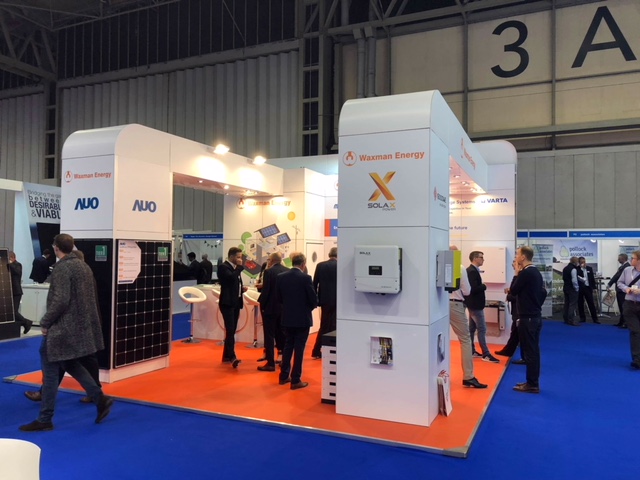
Waxman Energy, one of the UK’s leading specialists in the distribution of solar photovoltaic (PV) systems will introduce new associate company Waxman Renewables at Ecobuild 2012 (stand N3610).

Waxman Renewables has been established to specialise in the supply of biomass boilers and solar thermal systems. They offer pellet stoves and boilers from Red 365, the biomass arm of Italian stove giants MCZ, and solar thermal systems from Austrian firm TiSun, Turkish manufacturer Ezinc and Swiss company AMK.

Waxman Energy will be showcasing its extensive product portfolio which includes PV panels, mounting systems and inverters from some of the world’s leading solar manufacturers.

It is also using the event to introduce four major new PV supplier partnerships. The agreements, with LG Solar, part of global electronics giant LG Electronics; Suntech, the world’s largest dedicated manufacturer of PV; new but powerful market entrant Bosch Solar Energy, of German firm Bosch Group; and Panasonic (previously branded ‘SANYO’) with its highly acclaimed HIT PV panels, mean Waxman Energy will become a key UK distributor for some of the most widely-recognised solar brands in the world.

Richard Waxman, chairman of the Waxman Group said:  “We are delighted to add further renewable technologies to our portfolio with the launch of Waxman Renewables and wish to send out a clear message of our intention to become a leader in the field.

“We are equally delighted to announce our new PV supplier partnerships, which join Waxman Energy’s key founding PV supplier Phono Solar. These major brands are all synonymous with high technical specification and impressive research and development. They are also highly regarded for their efficiency and reliability, which we believe is of major importance to our customers and indeed, the end user.”

Waxman Energy’s enhanced product range, coupled with the practical advice and support offered by its technical team is a demonstration of the company’s commitment to offering a total quality package to customers.

Richard said: “Our stand at Ecobuild 2012 will be very comprehensive indeed. It will effectively be split in half, with one side focussing on our solar PV offer and the other on solar thermal systems and biomass boilers.

“We look forward to welcoming visitors onto our stand at the show, where we will have our technical staff on hand to answer any questions and where they will be able to find out more about our product range and meet the Waxman team.”

Waxman Energy and Waxman Renewables distribute nationally from The Waxman Group’s 40,000 sq ft warehouse complex in Elland, West Yorkshire. Both businesses benefit from The Waxman Group’s 50 years’ experience in the distribution industry. The Waxman Group was founded in 1958 and is also involved in distributing flame retardant fibre and mosaic and ceramic tiles.

Waxman Energy, one of the UK’s leading specialists in the design and distribution of solar photovoltaic (PV) systems, has promoted Mark Powell to the role of national sales director.

Mark joined The Waxman Group some nine years ago, originally starting out in operations, and making the transition to sales for Waxman’s ceramics business, before moving to Waxman Energy when it was established in 2007.

Richard Waxman, chairman of The Waxman Group said:  “Mark is a hugely passionate and driven individual. This coupled with his ability to lead our sales team while accessing new markets make him the perfect choice for this pivotal role, as we prepare for the next chapter in the growth of our business.”

Mark commented: “These are exciting times for the renewables industry and having witnessed the phenomenal growth of the PV sector over the past few years, I am delighted to take up the role of national sales director for Waxman Energy. I am looking forward to taking the business to the next stage in our growth, developing our presence in existing markets while seeking out and capitalising on opportunities in new ones.”

Waxman Energy is the main UK distributor for some of the world’s leading solar brands, including LG Solar, Suntech, Bosch Solar, Phono Solar and Panasonic.

From april 1, 2012, the brand for HIT® solar modules will be changed from “SANYO“ to “Panasonic“ in Europe. The change will be made to the brand only. There will be no change to the sales structure, warranties, functionality and the HIT® solar modules, which are highly appraised in Europe for their high conversion efficiency and reliability will continue to be manufactured at the same SANYO production bases as before. The brand change will be carried out throughout in Europe.

The brand change to “Panasonic” is being carried out in order to focus the management resources of the Panasonic group in order to create greater synergy and is part of the global strategy to expand the solar business of the Panasonic group. Panasonic will continue to provide investment into the solar business, allowing them to offer their customers and business partners a higher level of service and high quality solar module

Until March 3rd we will be offering all our SMA products at project prices for all quantities ordered.

Waxman Energy are members of the following associations: REA (Renewable Energy Association)